
On the journey of artisans - Part 2 - eco-printing
The Wonder of Ecoprinting
Guest Post
I have always admired eco-printed products; their beauty and natural feel captivate me, and I can say that once I tried eco-printing myself for the first time, I was completely hooked. Dyeing with natural dyes begins with collecting plants and flowers from nature, which is where the idea and origin of your unique eco-printed product truly come from. The dyes from plants and flowers are then transferred to fabric, perhaps in your own home kitchen, creating colors and patterns, and thus, a unique eco-printed product made from nature's bounty is ready to use.
Ecoprinting is full of surprises. This element of surprise actually adds more excitement and interest to bio-dyeing, where the outcome is determined by what nature decides to bestow. Plants often bring surprises, so it's best to approach eco-printing with a relaxed attitude and enjoy the process, as it's not entirely controllable. Room must be given for chance and creativity, making eco-printing an inspiring and fascinating technique overall.
About Ecoprinting
As spring progresses, nature's offerings expand, providing ecoprinters with many opportunities. Spring and summer are the golden age for ecoprinters regarding plant leaves and flowers. By late summer, plant leaves often yield little to no color, but for example, lily-of-the-valley leaves only release their color after they wilt in autumn. I have also achieved stunning ecoprints on fabric even in autumn from dried fireweed blossoms, so it's worth being curious and just diving in with experiments.
Many factors influence the formation of eco-printed patterns, such as the season in which the plant was collected, where it was collected from, and even the soil's moisture content. Dried plants can also be used for eco-printing, but they must be soaked before use. During summer, it's a good idea to dry plants for winter eco-printing, although plants can also be found in flower shops year-round. The mordants and the material being dyed also affect the final result of the dyeing.
Natural fiber fabrics are best for eco-printing. Thin cotton and linen fabrics are excellently suited for this dyeing technique, as are silk and wool fabrics. Colored fabrics can also be printed. Small fabrics are well-suited for this technique, and large fabrics are practically impossible to eco-print unless industrial steaming equipment is available.
To fix the dyes, fabrics often need to be mordanted with a mordant (e.g., powdered alum that is dissolved). Such a mordant acts as an auxiliary to carry the plant's dye into the fabric fibers and keep the dye attached to the fabric. Some plants naturally contain their own mordants (e.g., nettle). Without mordants, patterns printed with plants will be pale and will fade further or disappear completely in washing.
The colorfastness in ecoprinting is comparable to plant dyeing in general.
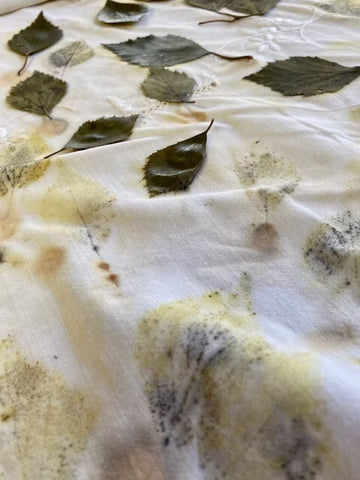
Among plants, eucalyptus leaves produce the strongest pattern and shades. From Finnish plants, I noticed in my experiments that birch leaves and dried and pressed fireweed blossoms gave the best prints.
In spring and early summer, good plants include meadowsweet, raspberry, thimbleberry, pelargonium, lady's mantle, cranesbill, wild strawberry, and thimbleberry. Summer plant options also include oak, peony, maple, and the petals of aquilegia and rose. In late summer, it's worth trying rugosa rose, St. John's Wort, dahlia, pansy, black-eyed Susan vine, goldenrod, cosmos flower, clock vine, and marigold. On the other hand, any natural material that contains dyes will also release them, so by experimenting curiously, you can achieve a variety of interesting prints on different fabrics.
Ecoprinting technique in brief
Fabric plant patterns are made as follows: The washed and moistened fabric is mordanted with either alum or soy milk (soaked in alum water or painted wet with soy milk). Plants produce a stronger result by dipping them in iron water before arranging them on the fabric. The print result is always darker the more iron is used.
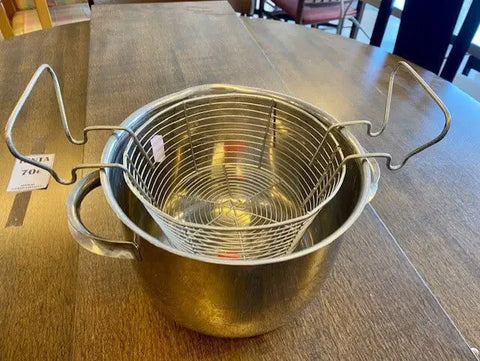
Once the plants are spread on the fabric, the fabric is placed on a backing fabric, moistened, folded, and rolled tightly. The roll is tied tightly before the actual printing. The fabric rolls are steamed for 1.5-2 hours, for example, in a pot with a grate; a juice extractor is also perfectly suitable for this. Once the fabrics have cooled, the plants are removed. The fabric is washed no earlier than one week later.
Ecoprinted fabrics in use
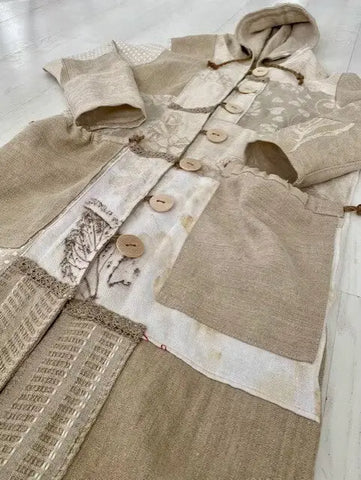
If the ecoprints are not to your liking, the process can always be redone. Additionally, by adding other techniques to the fabric, such as embroidery or another fabric, you can make the fabric more interesting. Ecoprinted fabrics can be used as beautiful utility items as they are, or they can be combined with other fabrics or projects. Here are some of my projects where I have used my own ecoprinted fabrics.
Ecoprinting eggs
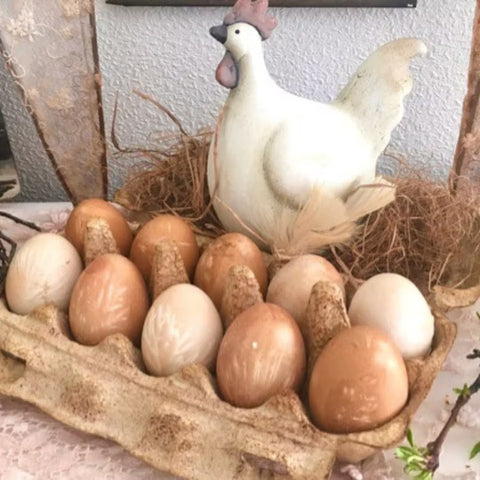
In addition to fabrics, you can ecoprint, for example, eggs. Since boiled eggs are eaten, natural dyes are perfectly suitable for them. Consequently, the colors don't need to last long. For eggs, I have experimented with mandarin peel, spruce sprout infusion, coffee, and lemon peel as dyes. For boiled eggs, I used plant leaves and coffee beans for ecoprinting, with the plants held on the egg surface by tying them with nylon stockings.
Bringing nature's beauty into everyday life through ecoprinting
I consider ecoprinting one of the most interesting techniques within natural dyeing. The method is easily implementable in your own kitchen, as the materials used for ecoprinting do not require separate workspaces. And what's most delightful, eco-printed fabrics always retain their unique ambiance, which is timeless and naturally beautiful, all year round.
For several years, I have written craft-related articles on my blog Värikäs Kädenjälki. In my article Surprising results and experiments in ecoprinting, you will find instructions for ecoprinting and many photos of my own ecoprints and experiments.
Using the keyword "ekoprinttaus" (ecoprinting), you can also find articles on ecoprinting eggs, a linen jacket, and ecoprinting my dress. Instructions for the belt bag can be found with the belt bag keyword, and for the needle case (also crochet hook and yarn holder) with the storage keyword.
I have also written an article about dyeing with food waste, which is dyeing with natural colors using food leftovers and scraps.
I hope this article inspires you to try this wonderful and surprising ecoprinting.
Tuija, writer of the Värikäs Kädenjälki blog